
Child Safety in Australia: What Parents Need to Know

In 2025, several high-profile investigations into early childhood services across Australia prompted national scrutiny of child safety systems. These events led to strengthened legislation, including Victoria’s Early Childhood Legislation Amendment (Child Safety) Act 2025, which significantly enhances oversight, accountability and safeguarding requirements.
While the vast majority of educators are committed professionals, these reforms recognise that child safety must be structurally embedded not assumed.
Why child safety systems are under review
Recent national inquiries and regulatory reviews have highlighted gaps in:
Consistency of Working With Children Checks (WWCC) across states
Oversight of early childhood education and care services
Workforce shortages affecting supervision and quality
Information-sharing between agencies when risks are identified
Governments are responding with tighter regulations, stronger enforcement powers and mandatory training requirements. These reforms aim to ensure child safety is not just policy but embedded in day-to-day practice.
Children’s safety must come first — in law
Strikingly, for the first time, the law now clearly states that “the safety, rights and best interests of children” are the paramount consideration in how early learning services operate.
In simple terms:
Every decision by providers, managers, educators and volunteers must put children’s safety first.
Even company constitutions and governance documents must reflect this obligation.
If there is a conflict between business interests and child safety, child safety wins.
This for many of us just seems incomprehensible that this was not law from the beginning. But now that it is there we have stronger legal backing if concerns arise. It shifts child safety from a policy principle to a legal requirement.

Stronger penalties for unsafe practices
The Act significantly increases penalties for serious breaches
Examples include:
Failing to adequately supervise children
Using inappropriate discipline
Operating without proper approval
Allowing unauthorised people on site
Ignoring compliance directions
In many cases, maximum penalties have been tripled.
This is designed to send a clear message: safety failures are not administrative oversights they are serious breaches.
Mandatory child protection and child safety training
This means:
Educators and relevant staff must complete formal training.
Regulators can direct staff or volunteers to complete additional training if required.
Services must embed safeguarding practices, not just rely on informal knowledge.
As parents you can ask:
How often is training completed?
Is it refreshed annually?
How are new staff onboarded into safety procedures?
Tighter controls on recruitment and screening
The Act introduces new powers relating to recruitment agencies and false information
Key changes include:
It is now an offence to give false or misleading information about a prohibition notice.
Recruitment agencies can be required to provide information to regulators.
Regulators can share information about enforceable undertakings or prohibition notices with providers.
In practical terms, this strengthens background screening and reduces the chance of someone moving between services without their history being visible.

A new National Early Childhood Worker Register
The reforms establish a National Early Childhood Worker Register
While implementation details will evolve, the intent is clear:
Improve transparency about workforce status
Strengthen monitoring across jurisdictions
Reduce loopholes between states
For families, this supports more consistent oversight nationally.
Addressing “systemic risk” — not just individual incidents
A significant shift in the legislation is the concept of systemic risk
This allows regulators to look beyond a single centre and consider:
Governance and ownership structures
Related providers operating multiple services
Patterns of non-compliance across a network
If a risk is identified, the Regulatory Authority can:
Amend conditions on approvals
Suspend or cancel approvals
Refuse new service applications
Impose additional oversight requirements
This means safety issues in one service can no longer be isolated if they reflect broader governance problems.
Stronger enforcement powers
The Act expands regulatory powers, including:
Powers of entry to premises
Ability to issue prohibition notices
Emergency closure powers
Disciplinary proceedings
Publication and disclosure of certain information
Regulators can also suspend action timelines if another investigation is underway, extending the window to commence proceedings.
This strengthens the ability to respond thoroughly rather than quickly but superficially.

What this means for parents
These reforms are about strengthening the system, not signalling that all services are unsafe.
Most educators are dedicated professionals. However, legislation recognises that safeguarding must be embedded structurally, not assumed.
Parents can feel empowered to:
Ask about compliance history
Request information about child protection training
Understand supervision practices
Clarify how incidents are reported
Raise concerns early
The law now explicitly supports a culture where child safety is non-negotiable.
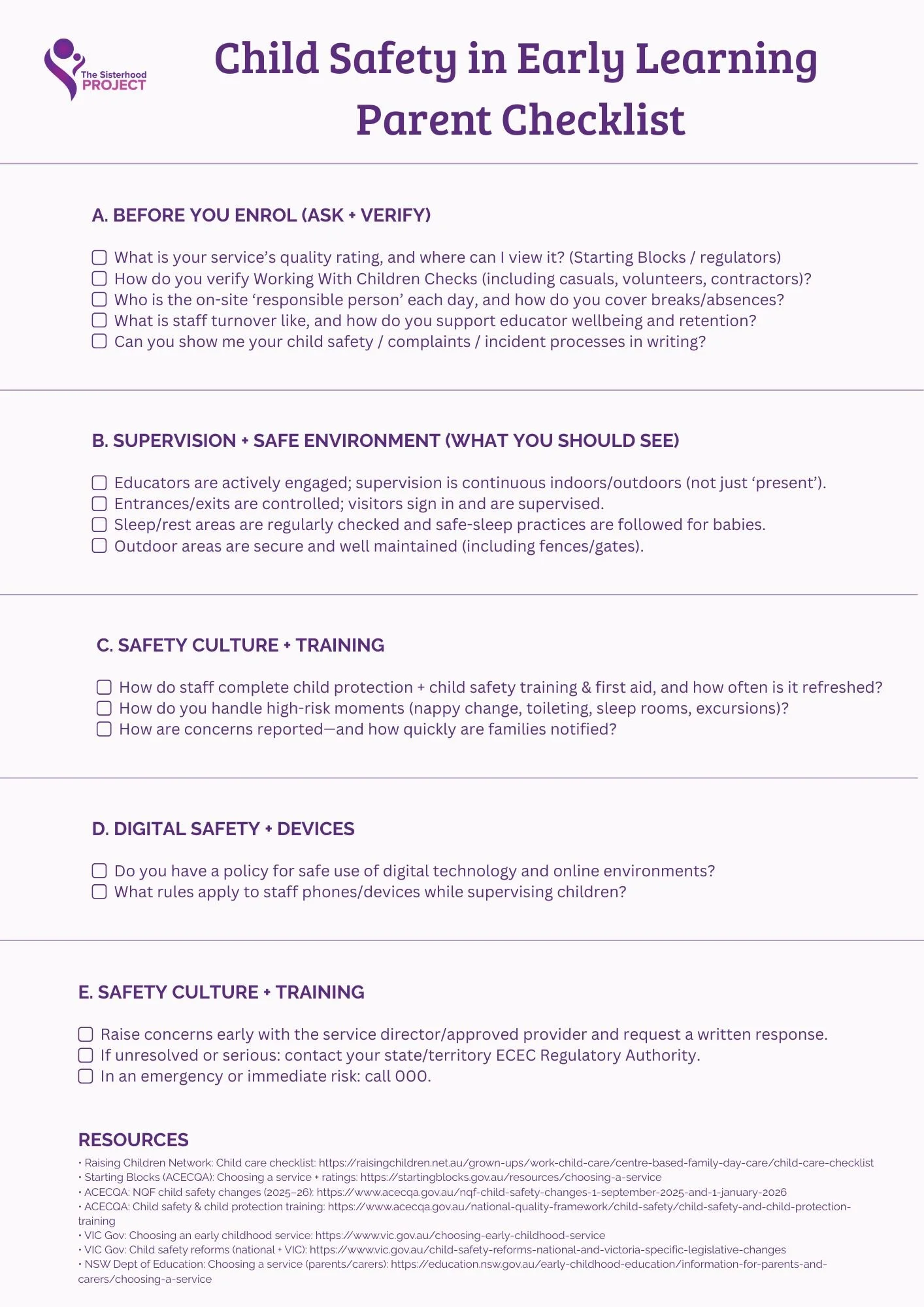
Child safety in early learning checklist
We’ve created a 1-page Parent Child Safety Checklist that brings together guidance from Raising Children Network, ACECQA/Starting Blocks and updated child safety legislation all in plain language.
Use it when:
Touring childcare, kindergarten, OSHC or family day care
Reviewing your current service
Raising a concern
Wanting confidence that safety is embedded not assumed
Click on the image of the checklist to download
References
Early Childhood Legislation Amendment (Child Safety) Act 2025 (Vic)
ACECQA – National Quality Framework (NQF) Child Safety Updates (2025–26)
https://www.acecqa.gov.auStarting Blocks (ACECQA) – Choosing a Quality Early Learning Service
https://startingblocks.gov.auAustralian Government Department of Education – Quality & Safety in Early Childhood Education and Care
https://www.education.gov.au/early-childhoodRaising Children Network – Child Care Checklist for Parents
https://raisingchildren.net.auVictorian Government – Child Safety Reforms
https://www.vic.gov.au
